
Collective Nouns Usage-Special Grammar Case-4
Collective Nouns in American and British English
Introduction
Collective nouns refer to a group of people, animals, or things, treated as a single unit. Examples include team, family, audience, government, staff, and jury. Understanding collective nouns usage is essential because American and British English treat them differently, often leading to confusion for students and professional writers alike. While the core definition remains the same, the grammatical application shifts based on geographic and cultural linguistic norms. Consequently, the way we perceive a group—either as a singular monolith or a collection of individuals—dictates the very structure of our sentences.
Collective Nouns in American English
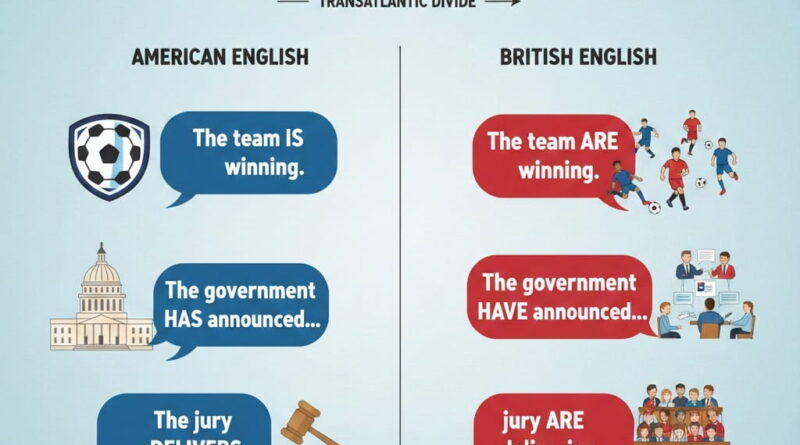
In American English, collective nouns are usually treated as singular. Consequently, the group is seen as one whole unit rather than many individuals. This reflects a “holistic” view of the entity, where the collective identity supersedes the individual members. Therefore, Americans say:
- The team is winning the match.
- The government has announced new policies.
- The jury delivers its verdict tomorrow.
Here, the focus stays on the group as a single entity. Furthermore, writers in America almost never use plural verbs with collective nouns unless the sentence explicitly emphasizes individuals acting separately. For example:
The staff are working on different projects.
Even in this case, the meaning highlights individuals rather than the whole group. However, many American style guides, such as the AP Stylebook or The Chicago Manual of Style, might suggest rephrasing this to “Staff members are working…” to avoid the singular/plural friction entirely. Thus, collective nouns usage in American English stays mostly singular to maintain a sense of formal unity and grammatical simplicity. This preference for the singular also extends to corporate entities; an American would say “Apple is releasing a new phone,” whereas a Briton might say “Apple are.”
Collective Nouns in British English
In contrast, British English often treats collective nouns as plural. Because of this, the group is seen as many individuals working together toward a common goal or existing in the same space. Therefore, the British would say:
- The team are winning the match.
- The government have announced new policies.
- The jury are delivering their verdict tomorrow.
Similarly, this pattern shows a difference in viewpoint. The British focus on the individuals within the group rather than the group as one. However, singular usage also appears when the writer emphasizes the group’s unity or its size as a measurement. For instance:
The audience is large tonight.
Accordingly, collective nouns usage in British English can shift between singular and plural depending on the writer’s intention and the specific context of the action. This flexibility, while confusing to some, allows for a greater degree of nuance in describing how a group operates. If the group is acting in total unison, the singular is used; if the group is acting as a collection of people with their own roles, the plural is preferred.
Deep Dive: Notional Agreement vs. Formal Agreement
To truly master collective nouns usage, one must understand the concepts of formal agreement and notional agreement. These linguistic theories explain why the Atlantic divide exists in the first place.
First, Formal Agreement follows the literal grammatical form of the noun. Since “team” is a singular noun—it doesn’t end in ‘s’—it takes a singular verb. This is the preferred American method. It is logical and follows a strict adherence to the morphology of the word. Second, Notional Agreement is more common in British English. It follows the notion or the idea of what the word represents. Since a “team” is made up of multiple people, the mind “sees” a plural, and thus uses a plural verb.
As a result, a British football commentator might say, “England are playing well,” while an American counterpart would say, “The United States is playing well.” To an American ear, “England are” sounds like a mistake; conversely, to a British ear, “England is” sounds overly clinical or even slightly odd when referring to a group of players. These deep-seated habits are rarely questioned by native speakers, yet they represent a fundamental shift in how the mind processes social structures through language.
Exploring Animal Kingdom Collectives
When we move beyond human groups, collective nouns usage becomes even more colorful. Animals often have unique collective nouns, known as “terms of venery.” Whether you are in London or New York, the rules of singular vs. plural still apply, but the nouns themselves change. For instance:
- A murder of crows.
- A pride of lions.
- A school of fish.
In the US, you would typically say, “The pride of lions is hunting.” Meanwhile, in the UK, you might frequently hear, “The pride of lions are hunting.” Regardless of the verb, choosing the specific noun communicates a deeper level of fluency. Furthermore, these terms add a layer of poetic precision to descriptive writing. Understanding these terms is not just about grammar; it is about embracing the rich history of the English language, which has spent centuries developing specific names for specific groups.
The Impact of Context on Collective Nouns
Beyond the regional differences, the specific context of a sentence can force a shift in collective nouns usage. Even in American English, there are moments where a singular verb feels “wrong” because the action being performed cannot be done by a single unit. Consider the noun “couple.” While it is technically a collective noun, saying “The couple is kissing” feels slightly detached compared to “The couple are kissing,” because kissing requires two distinct individuals.
Furthermore, words like “data” or “media” often function as collective nouns. Traditionally, “data” is the plural of “datum,” and “media” is the plural of “medium.” However, in modern usage, “the data is” has become increasingly common in both American and British professional circles. This evolution shows that collective nouns usage is not static; it responds to the needs of the speakers and the technological era we inhabit.
Similarly, consider the word “committee.” If a committee is divided in its opinion, the plural is almost mandatory to convey the lack of unity: “The committee were unable to agree on a chairman.” If you used the singular “was,” it would imply the committee as a single unit had the quality of disagreement, which is a logical paradox.
Linguistic Evolution and Global English
In the modern era of the internet, the lines between American and British collective nouns usage are beginning to blur. With the global consumption of American media and British literature, many speakers are becoming “bi-dialectal.” For instance, Australian and Canadian English often sit somewhere in the middle, leaning toward the British plural for sports teams but the American singular for government bodies.
Moreover, as English continues to serve as a lingua franca for international business, a “Global English” is emerging. In this version of the language, the singular usage is often preferred because it is simpler for non-native speakers to learn and apply consistently. Nevertheless, for those aiming for a high level of sophistication, being able to toggle between these styles depending on the audience is a mark of true linguistic mastery.
Practical Tips for Learners
Initially, learners should decide whether to write in American or British style. Then, they should follow that pattern consistently throughout their text. For example, a student writing an essay in American English must keep collective nouns singular. On the other hand, someone writing in British English may freely use plural verbs with collective nouns.
In addition, writers should pay attention to meaning. If the focus is on unity, singular is best. If the focus is on individuals, plural is better. For example:
- The team is celebrating its victory. (The team is acting as one joyous unit).
- The team are arguing among themselves. (Individual members are having different disagreements).
Furthermore, it is helpful to look for “trigger” words. Words like each, every, and individual usually suggest that you should treat the collective noun as a plural or rephrase the sentence to include the word “members.” For example, “Every member of the jury was present” is much clearer than trying to decide if “the jury were present” sounds right in your specific dialect.
Finally, consistency is very important. Mixing both styles in the same piece of writing—such as using “the committee has” in one paragraph and “the committee have” in the next—creates confusion. Consequently, the writing appears unpolished and unprofessional. To avoid this, many professional editors recommend picking a “base” style guide and sticking to it religiously.
Advanced Nuances: The Case of “Proper” Collective Nouns
Proper nouns that represent groups, such as “The Beatles,” “The United Nations,” or “Microsoft,” add another layer of complexity to collective nouns usage. In British English, it is incredibly common to hear “The Beatles were a great band,” but also “The Beatles are releasing a new documentary.” The focus is on the four individuals.
In contrast, an American might say “The Beatles was the most influential band in history” when viewing them as a historical phenomenon or a single brand. However, even Americans usually default to the plural for band names because they end in ‘s’. The real test comes with names that do not end in ‘s’, like “Pink Floyd.” An American would say “Pink Floyd is,” while a Briton would almost certainly say “Pink Floyd are.”
This distinction is also vital in sports. In the United States, team names are almost always plural (“The Lakers are,” “The Yankees are”), but the city names representing them are singular (“Los Angeles is,” “New York is”). In the UK, however, even the city name is treated as a plural when it represents a team: “Liverpool are top of the league.”
The Psychology of Collective Nouns
Psychologically, our choice in collective nouns usage reveals how we view social hierarchy and agency. When we use the singular, we give the “entity” a sense of power and independent existence. When we use the plural, we humanize the entity, reminding the reader that it is made of flesh and blood.
For example, a journalist writing about a corporation’s mistake might use the plural to highlight the culpability of the people involved: “The board are responsible for the loss.” Conversely, a corporate spokesperson might use the singular to deflect individual blame: “The company is moving in a new direction.” This subtle shift in grammar can significantly alter the tone and perceived responsibility in professional communication.
Conclusion
In summary, collective nouns cause confusion because their usage differs between American and British English. In America, collective nouns are mostly singular, favoring formal agreement and a holistic view of groups. In Britain, they are often plural, favoring notional agreement and highlighting the individuals within the collective. Ultimately, writers must choose one style and remain consistent to ensure their message is received clearly.
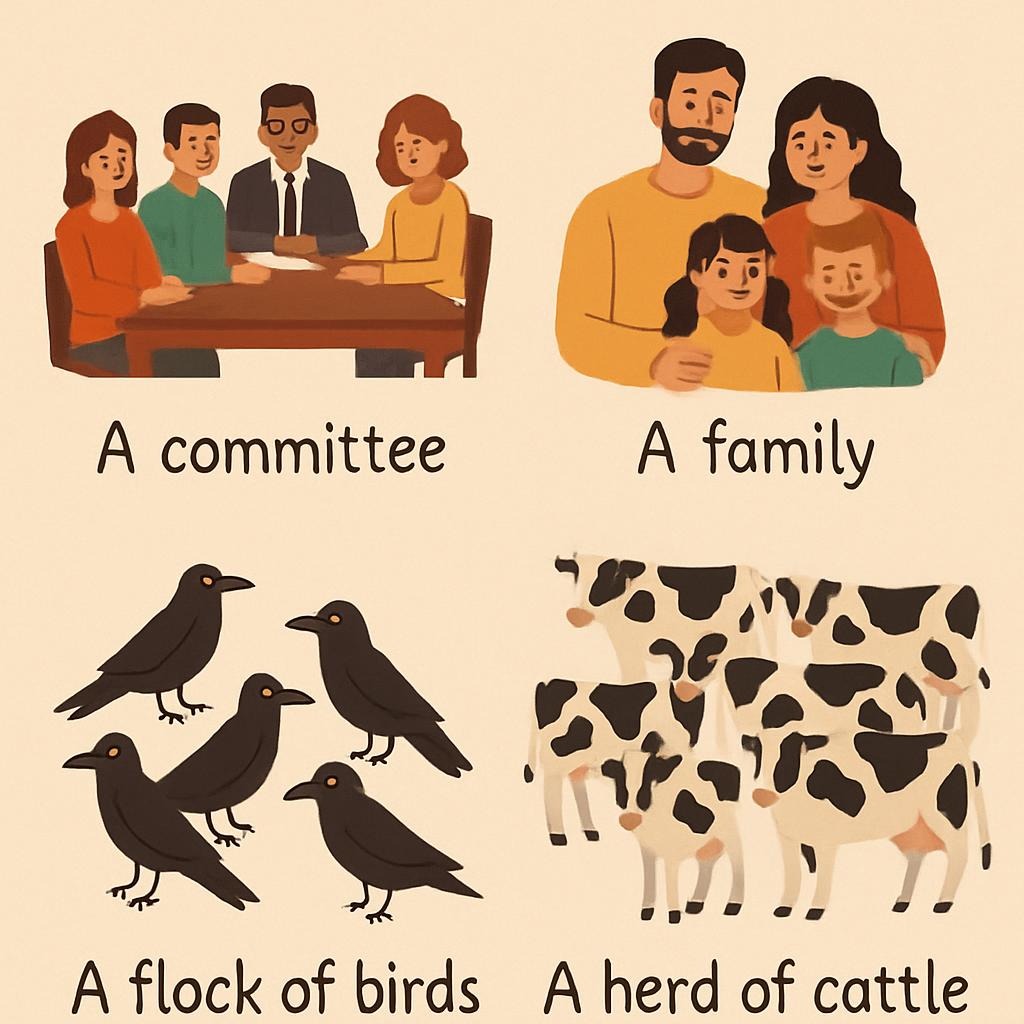
Therefore, mastering collective nouns usage improves clarity, prevents mistakes, and shows confidence in English writing. Whether you are describing a “herd” of cows, a “faculty” of professors, or a “staff” of employees, your verb choice is a signal to your reader about your background, your audience, and your perspective on the world. By paying attention to these small grammatical details, you transform your writing from merely functional to truly professional.
Double Plural Nouns Error: https://grammarpuzzlesolved.englishlitnotes.com/double-plural-nouns-error/
To read English Literature Notes, follow the link: http://englishlitnotes.com
To read Canadian Literature, follow the link: http://canlitstudies.blogspot.com
Discover more from Grammar Puzzle Solved by Naeem Ullah Butt
Subscribe to get the latest posts sent to your email.