
Errors in the Use of Nouns (6)-GPS-54
Common Noun Usage Mistakes
Writing clear English requires great precision. Many writers struggle with simple nouns. These small words carry heavy weight. One wrong letter changes your meaning. This guide fixes those common noun usage mistakes. We will explore essential rules today. You will write with new confidence.
Rule 18: Master Countable and Uncountable Nouns
Nouns fall into two main camps. Some things we can count easily. We call these countable nouns. Examples include chairs, books, and apples. Other things exist as a mass. We call these uncountable nouns. Examples include water, advice, and information.+1
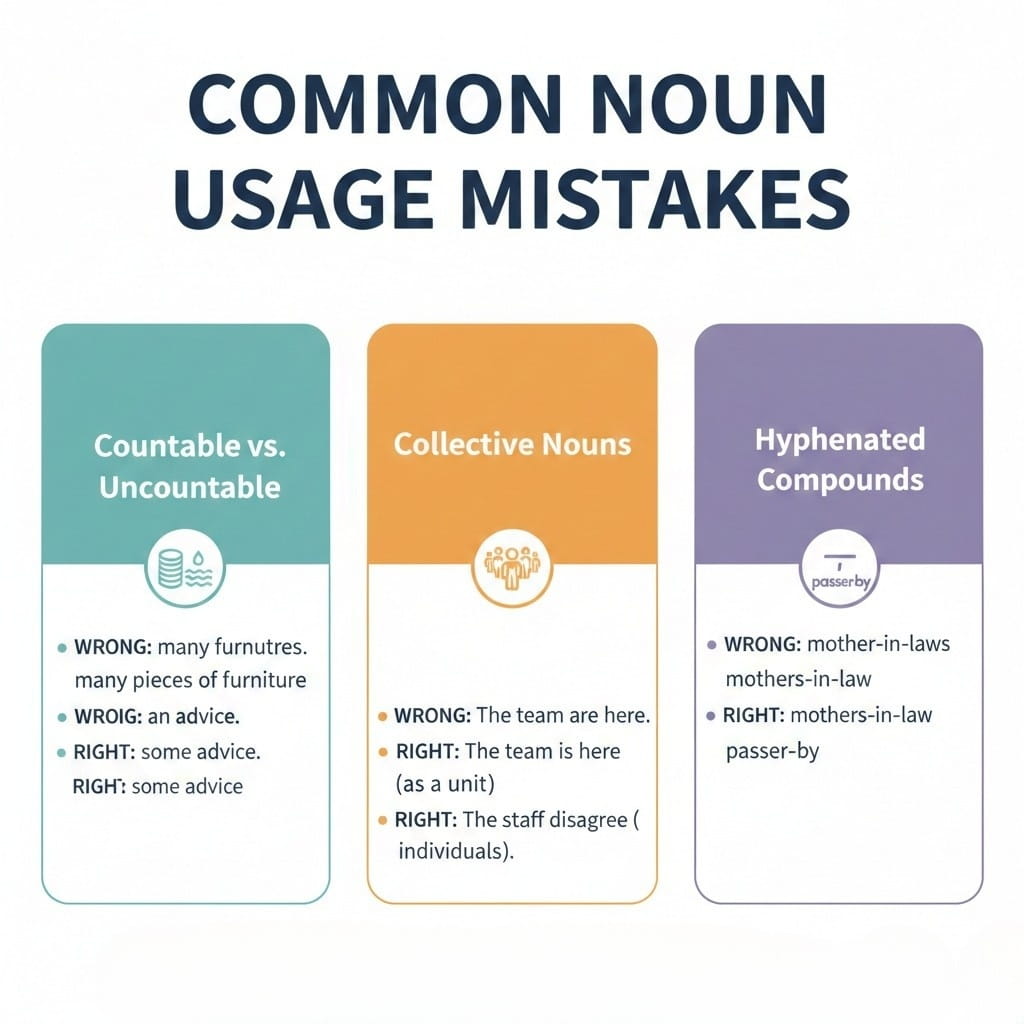
Never add “s” to uncountable nouns. This is one of the most common noun usage mistakes. Do not say “informations.” Use “information” for one or many facts. Similarly, “furniture” stays singular. You cannot buy “furnitures” for your home. Use “pieces of furniture” instead. This distinction keeps your prose professional.
Countable nouns have clear plural forms. You can say “one dog” or “ten dogs.” Uncountable nouns do not work this way. You cannot say “three moneys.” Instead, you must say “some money.” You can also say “much money.” This rule prevents many common noun usage mistakes. Many students fail to see this difference.
Think about the noun “luggage.” You may have many bags. However, “luggage” remains a mass noun. Never say “luggages” at the airport. Use “items of luggage” instead. This approach shows a high skill level. Precise nouns build a strong foundation.
Knowledge is also an uncountable noun. We never speak of “knowledges.” We gain “broad knowledge” through study. This nuance is vital for academic writing. It helps you avoid common noun usage mistakes. Your teachers will notice your accuracy.
Similarly, “work” can be very tricky. “Work” as a job is uncountable. You have “much work” to do. However, “works” can mean art pieces. “The works of Shakespeare” is correct. Context changes the rule completely. Always identify the noun type first.
Rule 19: Solve the Collective Noun Puzzle
Collective nouns represent groups of people. Words like team, choir, and faculty fit here. These words look singular. Often, they act as singular units. However, context determines the correct verb.
If the group acts together, use singular verbs. Say, “The team wins every single game.” Here, the team moves as one. If members act individually, use plural verbs. This nuance helps you avoid common noun usage mistakes. For example, say “The staff disagree on the plan.” They are thinking as separate individuals. Always check the intent of your sentence.
In American English, singular is standard. “The government is making a choice.” British English often prefers the plural. “The government are making a choice.” Both styles aim to avoid common noun usage mistakes. Choose one style and stay consistent.
Consider the word “jury” in court. The jury reaches one single verdict. Use a singular verb here. Say “The jury has decided.” Sometimes the jury members argue. Use a plural verb then. Say “The jury are arguing.” This shows individual actions within the group.
“Family” is another common collective noun. “My family is very large.” This describes the unit. “My family are all eating.” This describes the individuals. Small changes in verbs matter greatly. They prevent common noun usage mistakes in stories.
“Audience” works the same way. “The audience claps for the star.” They act as a single crowd. “The audience are leaving their seats.” They move as many people. Observe how the verb follows the action. Correct verbs make your writing flow.
Rule 20: Navigate the Hyphenated Compound Noun
Compound nouns combine two or more words. Sometimes we use hyphens for these. Pluralizing them gets very tricky. Many writers put the “s” at the end. That is a frequent error.
Always pluralize the principal word first. This prevents common noun usage mistakes in formal writing. Say “mothers-in-law,” not “mother-in-laws.” The “mother” is the main noun. Likewise, use “passers-by” for multiple people. Do not say “passer-bys.” Focus on the core subject of the phrase. This rule ensures your grammar stays sharp.
Consider the term “editor-in-chief.” The “editor” is the person. For many, say “editors-in-chief.” Do not pluralize “chief.” This is one of those common noun usage mistakes. It happens often in business memos.
Look at “commander-in-chief” as well. Multiple leaders are “commanders-in-chief.” The title stays with the person. Hyphenated words require extra care. Always look for the head word.
“Attorney-at-law” follows this pattern too. Say “attorneys-at-law” for a group. The “law” part never changes. Mastering this creates a polished look. You will avoid common noun usage mistakes easily.
Even simple words like “runner-up” change. Say “runners-up” for the losers. “Up” is just a particle. It cannot be plural. This logic applies to most compounds. It keeps your English very clear.
Rule 21: Handle Nouns Ending in “S”
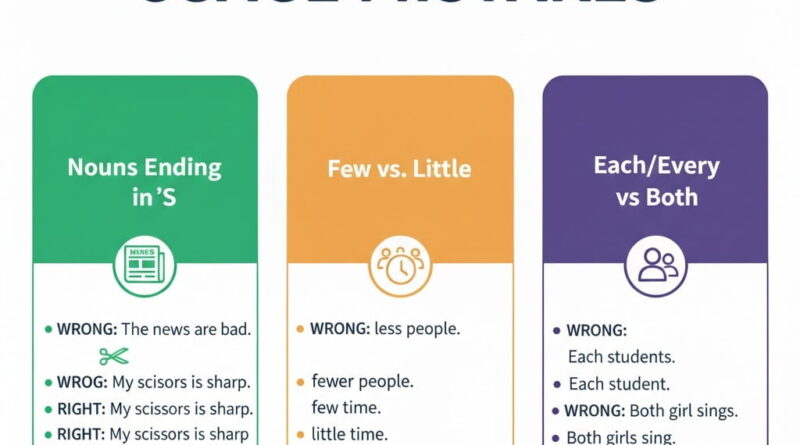
Some nouns always end in “s.” Words like scissors, pants, and news apply here. However, their grammatical numbers differ. “News” always takes a singular verb. Do not say “The news are bad.” Say “The news is bad.” This is among the common noun usage mistakes beginners make.
Conversely, “scissors” and “pants” are always plural. You must use a plural verb with them. Say “These scissors are very sharp.” If you want a singular form, add “pair.” Say “This pair of pants fits well.” Understanding these quirks prevents awkward phrasing. Your readers will appreciate your attention to detail.
“Mathematics” also ends in “s.” It acts as a singular subject. Say “Mathematics is my favorite class.” Never say “Mathematics are hard.” This error is quite common. It falls under common noun usage mistakes.
“Physics” and “Ethics” work similarly. They describe one field of study. Use singular verbs for these subjects. “Ethics is a complex topic.” This shows you know the rules. You appear more intelligent to readers.
“Politics” can be very confusing. Sometimes it is a singular concept. “Politics is a dirty game.” Other times it refers to beliefs. “His politics are quite radical.” The context dictates the verb choice. This avoids common noun usage mistakes.
“Mumps” and “Measles” are diseases. They look plural but are singular. “Measles is highly contagious.” Treat them as one single condition. This keeps your medical writing accurate.
Rule 22: Distinguish Between “Few” and “Little”
Adjectives must match their specific nouns. We use “few” with countable nouns only. We use “little” with uncountable nouns only. Mixing these leads to common noun usage mistakes.
Say “I have few friends.” Friends are easy to count. Say “I have little time.” Time, as a concept, is uncountable here. Never say “less people.” Instead, say “fewer people.” “Less” belongs with mass nouns like sugar or water. Precise word choice clarifies your exact meaning.
Consider the word “amount” versus “number.” Use “amount” for uncountable things. “A large amount of sand.” Use “number” for countable things. “A large number of stones.” This stops common noun usage mistakes.
“Many” and “Much” follow this rule too. Use “many” for countable items. “Many trees grow here.” Use “much” for uncountable items. “Much rain fell today.” Your sentences will sound natural.
“Each” and “Every” take singular nouns. Say “Each student has a pen.” Do not say “Each students.” This is a major error. It is a part of common noun usage mistakes.
“Both” always takes a plural noun. Say “Both girls like to sing.” This keeps the count correct. Agreement is the key to grammar. It makes your prose very professional.
Why These Errors Happen Often
Language evolves fast in the digital age. We type quickly on small phones. Autocorrect often misses these subtle noun errors. Therefore, manual proofreading remains vital for success. Most common noun usage mistakes stem from haste. Slow down while you edit your work.
Furthermore, native habits influence our writing. We often speak differently than we write. Informal speech permits many tiny errors. Formal writing demands much higher standards. You must master these rules for your career. Good grammar reflects a sharp, organized mind.
We often copy what we hear. If friends use slang, we might too. Slang often ignores proper noun rules. This leads to common noun usage mistakes. You must separate speech from writing.
Lack of reading also causes problems. Reading teaches you the correct forms. You see nouns used properly in books. Without reading, your skills will fade. Focus on classic literature for best results.
Stress also plays a big role. When tired, we make simple slips. These slips become common noun usage mistakes. Always rest before you do final edits. A fresh mind catches every error.
The Impact of Noun Errors on Credibility
Readers judge your authority by your prose. One mistake can ruin a great point. Common noun usage mistakes distract the audience. They stop reading to analyze your error. You lose their trust instantly.
Imagine a business proposal with grammar flaws. The client might doubt your professional skills. Clear nouns lead to clear business deals. Consistency shows that you care about quality. Your reputation depends on your linguistic accuracy.
Errors suggest a lack of care. If you miss nouns, what else? Clients worry about your overall work. You must present a perfect image. This starts with basic grammar rules.
In journalism, errors destroy the story. The reader stops believing the facts. Accuracy is the soul of news. Common noun usage mistakes kill that accuracy. Every journalist must be a grammarian.
In school, errors lower your grades. Professors want to see mastery. They want clear and logical essays. Noun errors hide your good ideas. Fix them to show your true potential.
Practical Tips for Daily Improvement
Read high-quality books every single day. Great authors model perfect noun usage. You will absorb these patterns naturally. Also, try writing short paragraphs daily. Focus specifically on one rule per week.
Next, use digital tools to catch errors. However, do not trust them blindly. Machines often fail to grasp deep context. You are the final judge of your text. Verify every suggestion the software makes. This habit eliminates common noun usage mistakes effectively.
Keep a small grammar notebook. Write down nouns that confuse you. Review this list every Sunday night. You will learn them over time. Practice makes your skills permanent.
Ask a friend to review work. A second pair of eyes helps. They might see common noun usage mistakes. You can help them in return. This creates a good learning loop.
Join an online writing community. Share your work for honest feedback. Other writers know the common traps. They will point out your errors kindly. Learning from peers is very helpful.
Final Thoughts on Noun Mastery
English grammar seems hard at first. Nouns are the foundation of every thought. Mastering them takes time and steady practice. You now know the most vital rules. Apply them to your next writing project.
Avoid common noun usage mistakes to stand out. Your voice will sound much more authoritative. Keep learning and stay curious about words. Success follows those who communicate with clarity. You have the tools to excel now.
Study these rules with great care. Nouns give names to our world. If names are wrong, confusion grows. Your goal is perfect communication always. Use this guide as your roadmap.
Finally, remember that grammar is a tool. It serves your unique writing style. It should never limit your creative spirit and only make it stronger. Go forth and write with power.
For the reading of English Grammar Rules, follow the link: http://grammarpuzzlesolved.englishlitnotes.com
To read notes on English literature, follow the link: http://englishlitnotes.com
To read Canadian literature, follow the link: http://canlitstudies.blogspot.com
Discover more from Grammar Puzzle Solved by Naeem Ullah Butt
Subscribe to get the latest posts sent to your email.