Use of Much and Many-GPS-32
Use of Much and Many: A Simple Grammar Rule Explained
What is the difference between much and many in English?
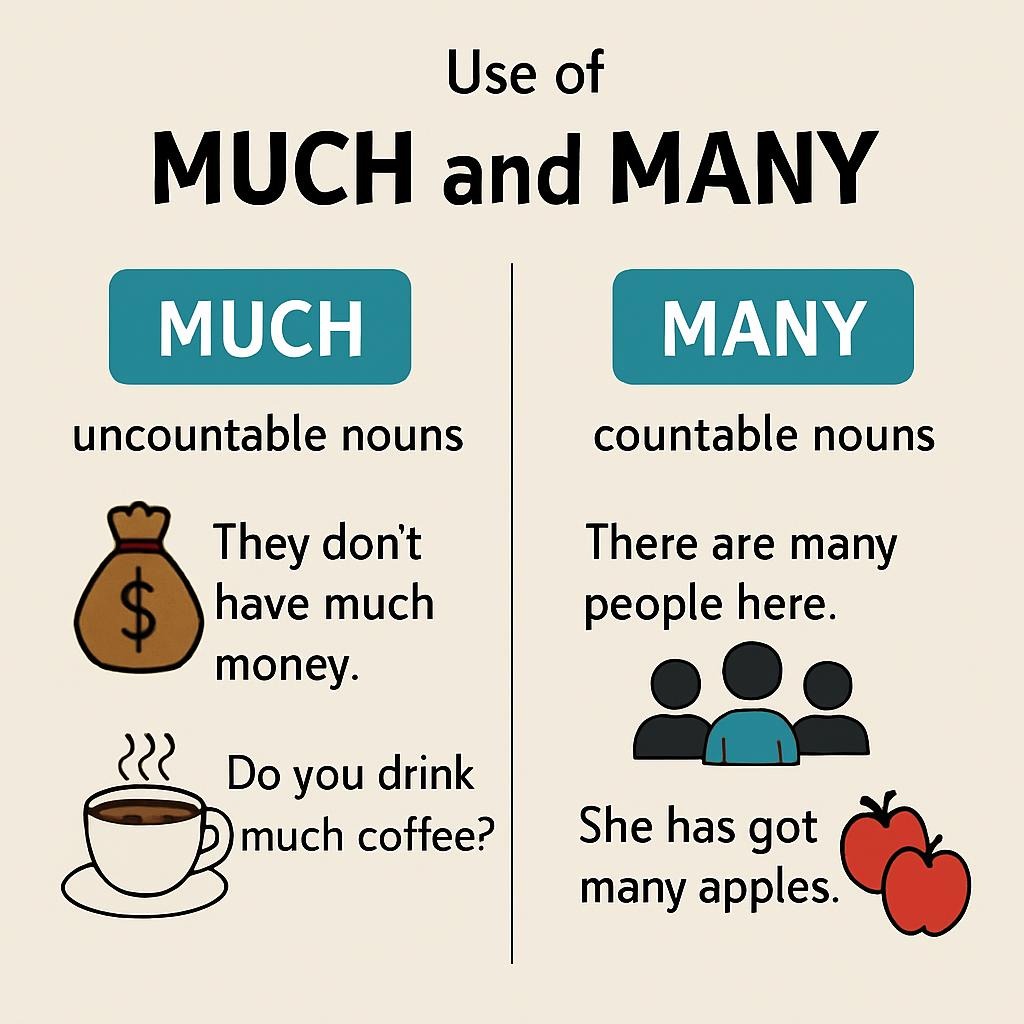
Understanding the difference between the use of much and many is essential for speaking and writing correctly. These two words seem similar. However, they are used in different situations. This grammar rule depends on whether a noun is countable or uncountable. Mastering this difference will improve both your clarity and accuracy in English.
How to Identify Countable and Uncountable Nouns
To grasp the difference, you must first understand noun types. Generally, countable nouns can be counted individually. In contrast, uncountable nouns cannot be separated into individual units. Therefore, recognizing this distinction helps you apply the correct word—“much” or “many.” As a result, you can communicate more clearly and avoid common mistakes. Moreover, knowing noun types is the first step in mastering this grammar rule. Consequently, your writing becomes more accurate and precise.
Examples of countable nouns: apples, cars, pens, dogs, books
Examples of uncountable nouns: water, sugar, money, air, rice
Using ‘Many’ with Countable Nouns
Typically, the word “many” is used with countable nouns. These nouns, in most cases, have a plural form. In fact, you can count them one by one without difficulty. For example, words like apples, books, or chairs follow this rule. As a result, using “many” with them is grammatically correct. Therefore, understanding countable nouns is essential to apply “many” accurately.
- How many pencils do you need?
- There are many chairs in the room.
- She asked many questions during the lecture.
Using ‘Much’ with Uncountable Nouns
We use “much” when referring to uncountable nouns. These nouns do not take a plural form. They represent quantities that cannot be counted separately.
- There isn’t much milk in the fridge.
- How much water do you drink daily?
- He didn’t show much interest in the project.
Why the Difference Between Much and Many Matters
Clearly, getting the difference between these right helps readers and listeners understand your message better. On the other hand, mistakes can confuse your audience and weaken your communication. Fortunately, this grammar rule is easy to learn. With practice, you can quickly apply it in both writing and speaking. Thus, mastering it enhances both clarity and confidence.
Examples That Show the Difference
- Incorrect: How much bananas did you buy?
Correct: How many bananas did you buy? - Incorrect: I don’t have many money.
Correct: I don’t have much money.
These examples clearly highlight the difference between them.
Tips to Remember the Difference Between Much and Many
- Use “many” with things you can count: cars, pens, cats.
- Use “much” with items you measure: flour, rain, sugar.
- Ask: Can I count it? If yes, use “many.” If not, use “much.”
Everyday Use of Much and Many
Here are more real-life examples of the difference:
- Many students were absent today.
- She didn’t have much patience with the noise.
- How many emails do you get daily?
- How much time do we need?
Common Errors and How to Fix Them
Even so, advanced learners sometimes confuse the two. The best solution, however, is consistent practice. First, spot the noun. Next, check if it’s countable or uncountable. Then, choose “many” or “much” accordingly. Over time, this process becomes natural and automatic. Therefore, careful attention and repetition are key to mastering this distinction.
- Incorrect: There isn’t many water left.
Correct: There isn’t much water left. - Incorrect: I didn’t eat much apples.
Correct: I didn’t eat many apples.
Why Learners Struggle with This Difference
Learners often use “much” and “many” based on guesswork. That causes errors. But once the rule is clear, applying it becomes natural. The difference between much and many is small but powerful. It shapes the quality of your English.
Quick Grammar Check
Try this small quiz to test your understanding:
- How _____ people came to the party? → (Answer: many)
- I didn’t drink _____ juice. → (Answer: much)
- She bought too _____ shoes. → (Answer: many)
- They didn’t have _____ luck. → (Answer: much)
Practice like this daily to master the difference between these two.
Conclusion
In summary, the difference between much and many is based on noun type. Countable nouns go with “many.” Uncountable nouns go with “much.” Once you know the rule, you can apply it easily. Moreover, mastering this rule will improve your English grammar and boost your confidence.
Virginia Woolf’s Contributions to Modern Literature: https://englishlitnotes.com/2025/05/30/virginia-woolf-contributions/
Team Moon – Questions and Answers:
https://englishwithnaeemullahbutt.com/2025/05/10/team-moon/
Edward Taylor as a Poet: https://americanlit.englishlitnotes.com/edward-taylor-as-a-poet/
Difference between Connotative and Denotative Meanings: https://grammarpuzzlesolved.englishlitnotes.com/connotative-and-denotative-meanings/
For grammar lessons, visit ChatGPT to explore the platform and interact with the AI: https://chat.openai.com
Discover more from Grammar Puzzle Solved by Naeem Ullah Butt
Subscribe to get the latest posts sent to your email.